



This article was written by Dr Ryan Drew, Senior Lecturer in Exercise & Sport Science at the University of Newcastle and Accredited Exercise Scientist
When a bloke is struggling, the advice is often the same: “get out for a walk to clear your head” or “hit the gym to feel better”. It’s well-meaning, and it’s not wrong! Research shows that regular movement can improve mental health, including reducing symptoms of depression and anxiety. But for many men, there is a mismatch between knowing how exercise helps, which types are most effective, and using it as a regular tool to feel better.
This article looks at what the evidence says, what kinds of exercise boost mental health, and how men can make movement work for better mental health.
Why men’s mental health needs attention
Men are less likely than women to seek help for mental health concerns, and traditional ideas about self-reliance and “toughing it out” are commonly reported barriers. There are also time pressures, work commitments, family responsibilities and limited access to services, which often delay action until a problem becomes more serious. The consequences can be profound. In 2025, 3,283 Australians died by suicide, and 74% were men. The age-standardised rate was 17.3 per 100,000 for men, compared with 6.0 per 100,000 for women.
These figures are a reminder that men need support options that they feel accessible and acceptable. Exercise is one of them!
What the evidence says
A 2025 review of reviews pooled 97 systematic reviews covering more than 1,000 trials and 128,000 adult participants. It found that physical activity had meaningful effects on symptoms of depression, anxiety and psychological distress compared with usual care. The authors noted these effects were comparable to, or slightly greater than, those seen with psychotherapy and medication which have been widely used treatments for improving mental health.
A 2024 BMJ analysis of 218 trials with over 14,000 people with depression found moderate improvements from walking or jogging, yoga, strength training, mixed aerobic exercises, and tai chi or qigong. Effects appeared to be even larger for men than women when prescribing exercise alongside psychotherapy.
In this context, not only is exercise important for preventing mental health concerns but it plays a valuable part of overall mental health care, alongside treatments such as psychological therapy and medication where they are needed.
Types of exercise that help
The research suggests there is no single “best” option. What matters most is finding something you will do regularly and something you enjoy. Options with good evidence include:
- Aerobic activity: walking, jogging, cycling or swimming
- Strength training: using weights, resistance bands or body weight
- Yoga and other mind-body exercise: including tai chi and Pilates
- Group and social activity: team sports, walking groups or training with mates
Australia’s physical activity guidelines for adults and for older adults recommend 30 minutes or more of moderate to vigorous activity on most days per week, plus muscle-strengthening activities on at least two days.
But if that feels like a long way off, start smaller. Research and guidelines consistently show that some movement is better than none, and you can build up over time. If you want help getting started with weights, see our guide to strength training or get in touch with an Accredited Exercise Scientist or Exercise Physiologist.
Why men may need a different approach
Men don’t always describe low mood as “feeling sad”. That can make it harder to recognise when something is wrong. Changes such as irritability, poor sleep, drinking more alcohol, or pulling back from people can be the first signs that something isn’t right.
When researchers ask men what gets in the way of joining exercise interventions, they identify work pressures, past injuries, relationships with friends and family, body image and confidence issues, and a need for credible, relatable people to lead the way.
Programs designed for specifically men appear to help. A systematic review of male-only lifestyle programs found positive improvements in mental health-related quality of life, self-esteem and positive affect, though very few studies were designed to detect changes in mental health, so more research is urgently needed.
How to start
A helpful question to ask yourself is “What can I do this week that I could also repeat next week or sustain for the rest of my life?” (no need to set the alarm at 4am for a 20km run). Some practical strategies are to:
- Start where you are. A 10-minute walk after dinner counts. Build gradually.
- Attach it to something you already do. Walk part of the way to work or train after the school drop-off. Our tips on making exercise a habit can help.
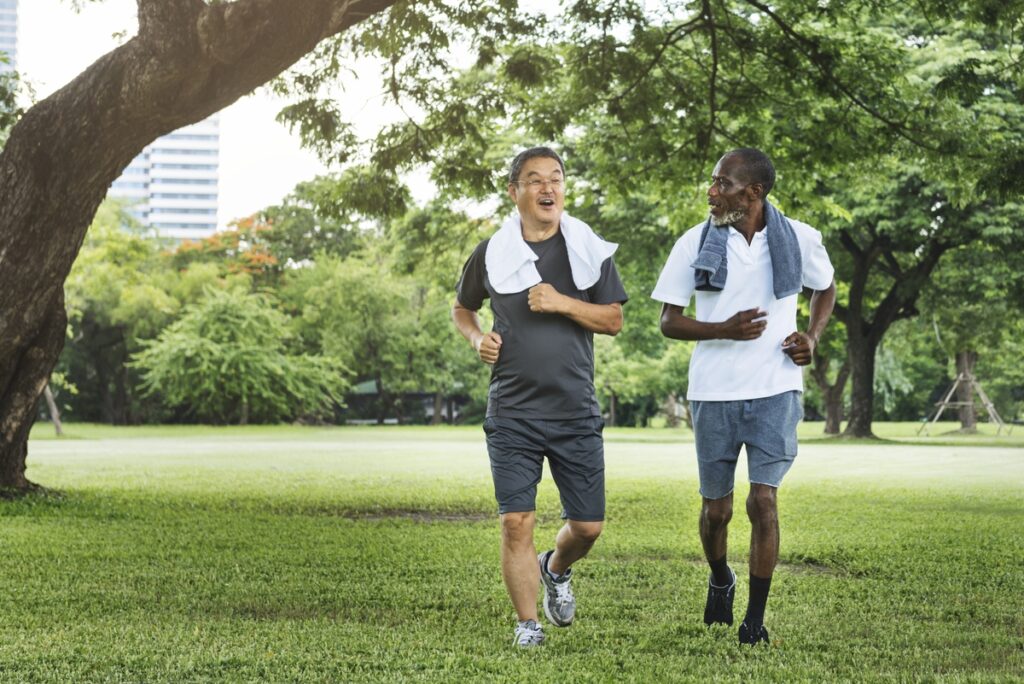
- Bring a mate. Moving side by side can make conversations easier, and a training partner makes it harder to skip a session.
- Mix it up. Combine aerobic activity with strength work and add some higher-intensity efforts when you feel ready.
- Measure how you feel, not just how you perform. Notice your sleep, energy and mood, not only your weights or times.
- Plan for the bad weeks. When motivation drops or life gets busy, do a shorter or easier session rather than nothing at all.
When you should get help
See your GP if low mood, anxiety, irritability or hopelessness has lasted more than a couple of weeks, or if it is affecting your work, relationships or sleep. Exercise can sit alongside other treatment, and your GP can help you work out what is right for you.
An Accredited Exercise Physiologist (AEP) can design a safe, personalised program, particularly if you have an injury, a chronic health condition, or haven’t exercised in a long time.
If you or someone you know is in crisis, contact Lifeline on 13 11 14 or MensLine Australia on 1300 78 99 78. In an emergency, call 000.
Progress looks different for everyone
You don’t need to be fit, or even feel motivated, to start. Just small amounts of regular movement can make a difference to how you feel. If you’re not sure where to begin, an AEP can help you find a starting point that suits your body, your other commitments and your goals.