



This article was written by Accredited Exercise Physiologist Georgina Keogh-Fisher for Diabetes WA.
If you’ve ever felt a bit unsteady on your feet, noticed your walking pattern has changed or found yourself worrying about falls, you’re not alone.
Balance is one of those things we mostly take for granted, until it starts to feel different. A small change in stability can make tasks like stepping onto a curb or walking on uneven ground feel harder than they used to.
The good news is that exercise, particularly programs targeting balance and muscle strength, is one of the most effective strategies for improving balance, building your strength and preventing falls.
Regular physical activity significantly reduces the risk of falls, particularly in active older adults who do not have any barriers to physical activity.
However, balance is not just about reducing your falls risk. Balance is the ability to maintain the body’s centre of mass within the base of support, whether standing, sitting, or moving. This means keeping your “centre of gravity” (roughly behind the belly button) positioned directly over your “base of support” (the area of contact with the ground, like your feet) to prevent falling.
So it’s also important for everyday activities that require balance, such as gardening or washing the car.
Diabetes and balance
Adults living with diabetes, particularly those with peripheral neuropathy, a condition affecting the feeling in the feet, have an increased risk of falls due to loss of sensation and reduced proprioception, which is the body’s ability to sense where it is in space.
These diabetes complications can affect stability. However, a combination of balance and strength exercise can help to reduce falls risk by improving the strength and coordination of the leg muscles.
Falls can often be predicted by assessing a combination of risk factors. Talk to your health care team if you notice any of the following:
- Feeling unsteady on your feet, stumbling or bumping into things.
- Finding simple tasks such as walking confidently or turning quickly harder than they used to be.
- Reduced muscle strength, which can sometimes be noticed when standing up from a chair or trying to undo jars.
- Feeling slower on your feet and noticing changes in your walking pattern, such as shuffling.
All these risk factors can be improved through targeted exercise.
Other falls risk factors, such as impaired vision, being on multiple medications and poor nutrition, require additional strategies.
What type of exercise works best?
Effective balance training typically involves standing, movement, narrowing the base of support and minimising hand support. Exercises that mimic real-life or task-specific movements will enhance your balance.
Not all exercise is equally effective. Strength training alone is not enough to prevent falls, and research shows that functional balance and muscle strength training are the most effective approaches.
Increasing exercise intensity
Programs that are functional, progressively challenging and ongoing, particularly those combining balance and strength training, offer the greatest benefit.
You can increase the intensity of a balance exercise by:
- Reducing the base of support (for example, standing on one leg).
- Adding dynamic movements (turning, stepping, reaching).
- Incorporating resistance (such as bands or weights).
- Reducing sensory input (eyes closed, unstable surfaces).
- Performing a memory or coordination task while doing a balance exercise.
It’s important to consider safety. Your exercise program needs to suit your abilities and current state of health and be supervised if necessary. It’s also a good idea to have some support within reach, such as a wall or sturdy chair.
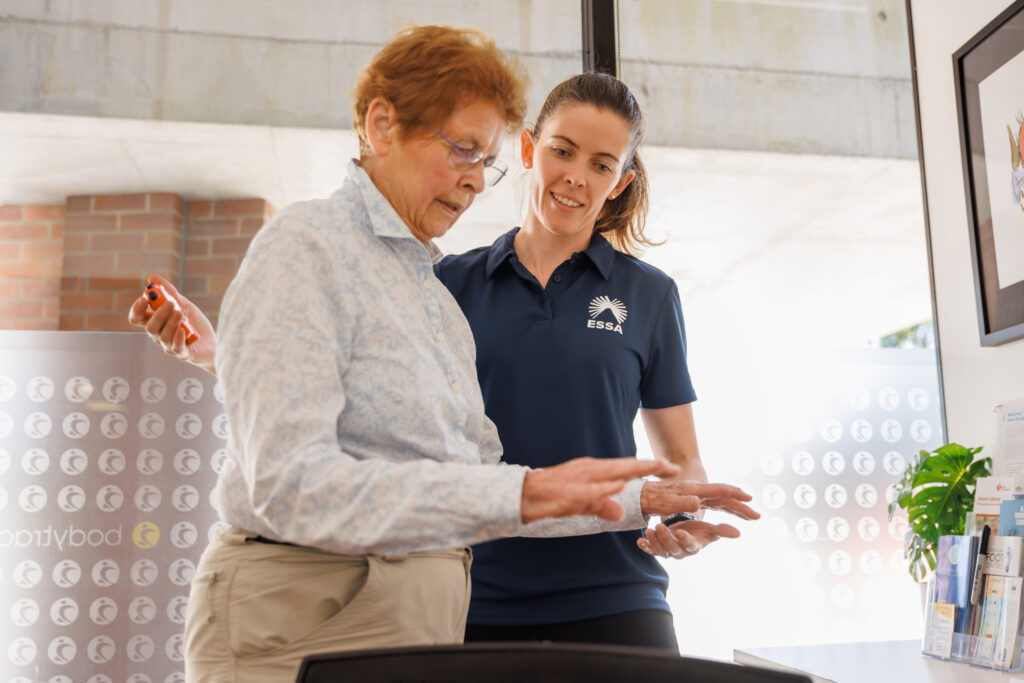
An exercise physiologist can design and supervise an exercise program for you.
Maintaining the benefits
The benefits of exercise are not permanent. When you stop an exercise program, any improvements in strength and balance, and the associated reduction in falls risk, are gradually lost. Therefore, ongoing participation is essential.
Exercise is a powerful, evidence-based tool for preventing falls in older adults and improving any balance-related activities you want to do, no matter your age.